
Evidence Is Not a Strategy: Game Theory in Public Health
Public health policy isn't won on data alone. Learn how game theory, incentive structures, and strategic coalition building move real-world legislation.iption.
Chad Sabora
7/26/20269 min read
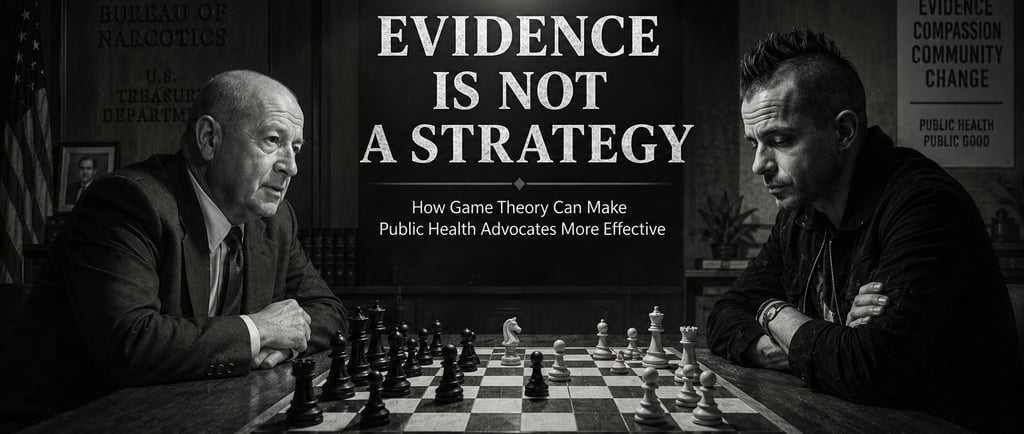
Evidence Is Not a Strategy
How Game Theory Can Make Public Health Advocates More Effective
By Chad Sabora
There is a memorable scene in A Beautiful Mind where John Nash and his friends notice a group of women across a crowded bar. The conventional strategy is obvious: every man competes for the attention of the same woman.
Nash reframes the problem. The best move cannot be determined by looking at one person’s preference in isolation. Each person’s outcome depends on what everyone else decides to do.
Whatever liberties Hollywood took with the mathematics, the scene captures the central insight of game theory: your best strategy depends on the anticipated choices of other people.
That insight matters far beyond economics. It applies anywhere people make decisions while anticipating how others will respond. Legislatures, regulatory agencies, boards, coalitions, and public institutions are all environments of strategic interaction.
Public health advocates often enter those environments believing that the strongest evidence should produce the strongest policy.
It should.
It frequently does not.
Evidence can establish that an intervention saves lives, reduces disease, or lowers public costs. Evidence cannot force a committee chair to schedule a hearing. It cannot make an agency surrender authority. It cannot eliminate a legislator’s fear of political retaliation. It cannot make organizations cooperate when each believes someone else should assume the risk first.
Evidence tells us what works. Strategy explains how to move people and institutions toward acting on it.
What Game Theory Actually Means
Game theory is a framework for analyzing situations in which the outcome for each participant depends partly on the choices made by others.
It developed through mathematics and economics, but its applications extend into political science, international relations, law, psychology, and the study of conflict and cooperation. The work of Thomas Schelling and Robert Aumann demonstrated how game theory could explain strategic behavior, negotiation, and cooperation among parties whose interests only partially align.
Calling legislative advocacy a game does not trivialize what is at stake. "Game" is a technical term. The consequences involve funding, healthcare access, criminal penalties, and whether people live or die.
Nor does game theory require us to believe that everyone is perfectly logical. In this context, rationality does not mean wisdom, compassion, or moral correctness. It means that people make choices based on what they value, what they fear, and what they believe other people will do.
Those values may include public health outcomes. They may also include reelection, institutional control, professional reputation, funding, ideological consistency, avoidance of blame, or simple political survival.
An advocate who assumes every decision maker is trying to maximize public health will misunderstand the game before it begins.
Why Evidence-Based Policies Still Lose
Consider syringe service programs. Decades of research have established that comprehensive syringe service programs reduce infectious disease, connect people with healthcare, and do not increase illegal drug use or crime. The Centers for Disease Control and Prevention describes them as safe, effective, and cost saving.
Yet legislation authorizing or protecting these programs continues to face opposition.
That resistance is often described as an information problem. Advocates respond by presenting more research, more testimony, and more evidence. Sometimes that works. Sometimes the opposing legislators already know the evidence.
Their concern may be that supporting the policy will expose them to attack. A law enforcement association may believe authorization will reduce its control over implementation. An agency may support the policy privately but resist statutory language that limits its discretion. A treatment provider may fear that a competing service model will redirect funding. A local official may care less about statewide health outcomes than about photographs of discarded syringes appearing before the next election.
In those circumstances, the obstacle is not a lack of information. The obstacle is the structure of incentives surrounding the decision.
The strategic question is no longer simply: "How do we prove that this policy works?"
It becomes: "What does each participant believe they will gain or lose by supporting it?"
The Players Are Not Always the Stakeholders
Advocacy campaigns often begin by identifying stakeholders. That is necessary, but it is not enough.
A stakeholder is someone affected by the outcome.
A player is someone capable of changing it.
Those categories frequently overlap, but not always. People who use drugs may face the greatest consequences from a legislative decision while possessing almost no formal authority over it. Conversely, a committee chair who has never met anyone affected by the policy may be able to stop the proposal without ever casting a public vote.
A complete strategic map must identify several distinct forms of power:
Formal Authority: The power to introduce legislation, schedule hearings, amend language, control funding, issue regulations, or sign a bill.
Informal Influence: The ability to shape media coverage, mobilize voters, provide political legitimacy, threaten opposition, or give a decision maker cover.
Veto Power: Held by anyone who can prevent the next necessary action, whether or not that authority appears on an official organizational chart.
The most visible opponent is not always the most important player. The person giving angry testimony may attract attention, while a legislative staff member, caucus leader, or agency attorney quietly determines whether the proposal moves.
Good advocacy begins by distinguishing noise from control.
The Anatomy of the Game
A useful game theory analysis examines six core elements:
The Objective: "Advance harm reduction" is a mission, not a strategic objective. The immediate objective might be securing a bill sponsor, obtaining a committee hearing, defeating a hostile amendment, preserving an appropriation, or persuading an agency to issue guidance.
The Players: Who can make the next decision? Who can block it? Who can influence the person with authority? Who appears powerful but cannot actually alter the outcome?
The Strategy: Supporting or opposing a proposal are not the only choices. A legislator can remain silent, request additional study, offer an amendment, move the issue into another committee, or privately encourage someone else to lead. Silence, delay, and procedural avoidance are strategies; do not mistake them for indecision.
The Payoff: A payoff is whatever a player values or seeks to avoid. Money can be a payoff, but so can reputation, control, political safety, media attention, or protection from blame.
The Information: Players rarely possess complete information about one another. Advocates may not know whether a legislator is genuinely opposed or merely afraid. A legislator may not know whether an advocacy coalition can mobilize voters. Much of political strategy involves reducing, protecting, or strategically revealing information.
The Sequence: Who moves first can change the entire outcome. Announcing a campaign before securing private commitments may force potential allies into a public corner before they are ready. Securing agency support first may make legislative support safer. The same message delivered at the wrong time can produce the opposite result.
Understanding Equilibrium
A Nash equilibrium exists when no player can improve their own outcome by changing strategy alone while everyone else keeps their strategy unchanged. It describes stability, not fairness, efficiency, or moral legitimacy.
A terrible outcome can be an equilibrium.
Imagine a state where several legislators privately support syringe service programs. The health department supports them but refuses to lead. Local officials wait for state authorization. Treatment organizations fear controversy. Law enforcement groups remain publicly opposed because they see no benefit in moving first.
Every participant may understand that the status quo produces poor public health outcomes. Yet no individual player can change the outcome without assuming political or institutional risk.
The result is a stable, destructive pattern: Private support. Public silence. No hearing. No authorization. Preventable harm continues.
That is an equilibrium. It is just a bad one. The purpose of strategy is to disrupt that stability.
How Advocates Change the Game
Successful advocacy does more than present the correct argument. It changes the conditions under which other people make decisions.
Change the Information: Evidence matters when uncertainty or misinformation prevents action. Local health data or an operational implementation plan may resolve concerns. But diagnose the information gap first. When someone accepts the evidence but fears the politics, dropping another stack of studies solves the wrong problem.
Change the Payoff: A legislator may privately support a policy but believe public support is politically dangerous. The strategic task is to make support safer. That might involve securing endorsements from trusted local institutions, recruiting an unexpected validator, or showing that inaction carries its own political cost.
Change the Available Choices: Policy debates are often framed as a binary choice between full adoption and total rejection. A pilot program, reporting requirement, phased implementation, or limited authorization may reduce uncertainty enough to permit movement. The question is whether a modified path preserves the essential public health outcome while lowering the cost of initial cooperation.
Change the Sequence: Advocates often begin with public pressure because it is visible and emotionally satisfying. Visibility is not always leverage. A better sequence may involve privately securing agency support, resolving technical objections, and obtaining commitments before launching a public campaign. Public pressure is most effective when forcing action from someone who already has the ability to act.
Change the Coalition: The largest coalition is not necessarily the most powerful one. Strategic coalition building focuses on pivotal players. A hospital system provides economic credibility. A prosecutor weakens claims that reform threatens public safety. The goal is not to collect logos; it is to assemble a team that changes how decision makers calculate risk.
Use Credible Commitments
Political actors often resist cooperation because they do not trust what will happen after a policy is adopted. A local official may fear that an organization will ignore community concerns. Law enforcement may fear losing input during implementation.
Advocates can reduce that uncertainty through credible commitments: clear implementation standards, public reporting, structured community input, or defined accountability procedures.
A promise becomes credible when breaking it would impose a real, measurable cost. "Trust us" is not an implementation strategy.
Advocacy Is a Repeated Game
Most public health policy work does not end after a single vote. The same advocates, agencies, legislators, and institutions will interact again over budgets, regulations, and future legislation.
In game theory, continuing interaction makes cooperation possible even among parties with conflicting interests. Because people expect to deal with one another again, today’s behavior dictates tomorrow’s opportunities.
Reputation is a strategic asset. Publicly humiliating a potential ally may produce quick applause while destroying future access. Accepting an empty promise to preserve a relationship teaches the other side that delay carries no cost.
Your reputation should communicate three things:
We provide accurate information.
We honor legitimate commitments.
We do not disappear when commitments made to us are broken.
That combination creates trust without inviting exploitation.
A Practical Example
Imagine a coalition seeking statewide authorization for syringe service programs. The coalition initially believes its problem is misinformation, so it prepares research explaining that these programs reduce infectious disease without increasing crime.
The evidence is sound. The bill still does not move.
A strategic analysis reveals the actual game:
The committee chair does not want a controversial hearing.
Several legislators support the policy privately but fear being portrayed as enabling drug use.
The health department supports authorization but does not want responsibility for defending the legislation.
A law enforcement association opposes the bill because it believes implementation will occur without local input.
Hospitals bear the cost of preventable infections but have not been asked to participate.
People who use drugs are invited to testify but have no role in deciding campaign strategy.
The existing equilibrium is stable because every institution is waiting for another to assume the political risk.
A strategy built on game theory proceeds differently:
The coalition defines the immediate objective as obtaining a committee hearing, not passing the entire bill.
It recruits hospital leaders to explain the financial and public health consequences of inaction.
It works privately with selected law enforcement officials to resolve operational concerns without surrendering the program’s evidence-based foundation.
It asks the health department to provide technical language and implementation standards.
It identifies legislators willing to support the bill if they are not required to move alone.
It includes people who use drugs directly in the strategy process rather than presenting their experiences as emotional decoration.
Only after those commitments are secured does the coalition increase public pressure on the committee chair. The evidence hasn't changed. The game has.
The Limits of the Framework
Game theory is a tool, not a crystal ball. People act inconsistently. Institutions contain competing interests. Fear, identity, and emotion can outweigh material incentives.
A strategic model must be tested against real behavior. Do not assume you know another person’s payoff because of their title or political party. Examine voting records, funding relationships, public statements, private conversations, and past behavior. A model built on invented motives is just fan fiction with a matrix.
Game theory also cannot determine what policy is morally right. Evidence, ethics, and the experiences of affected communities must establish the objective. Strategy simply helps advocates understand how to reach it.
Questions Before the Next Campaign
Before launching your next advocacy effort, ask these operational questions:
What exact decision must happen next?
Who has the authority to make it?
Who can stop it?
What does each player gain from action, delay, or opposition?
What does each player believe everyone else will do?
What keeps the current outcome stable?
Which move could change the information, payoff, choices, or sequence?
Which relationship will still matter after this decision is over?
Those questions do not replace evidence. They prevent us from wasting it.
Conclusion
Public health advocates are trained to communicate evidence, tell compelling stories, and respond to misinformation. Those skills matter. But the strongest argument does not automatically become law. The most moving testimony does not automatically receive a hearing. A room full of people agreeing with one another does not create power.
Game theory teaches us to examine the decision as an interaction rather than an isolated choice. It forces us to identify who controls the outcome, what makes the status quo stable, and what must change before cooperation becomes possible.
The lesson from A Beautiful Mind is not that we should outsmart everyone in the room. It is that no one chooses in isolation.
Evidence tells us what should happen. Power determines what can happen. Strategy connects the two
PHONE
314-717-3472
© 2025. All rights reserved.
Aftermath Strategies is a consulting firm dedicated to helping nonprofits in harm reduction and recovery build the structures, strategies, and systems they need to last.
Aftermath Strategies is a consulting initiative operating under Rebel Recovery LLC (LC001452438), a Missouri-registered limited liability company.